As part of its ongoing commitment to strengthening environmental education in the Amazon, Green Gold Forestry (GGF) has completed the 2025 cycle of its Environmental Curriculum—an annual initiative implemented since 2022 in schools located within the areas of influence of its forest concessions, primarily in the Napo and Marañón river basins.
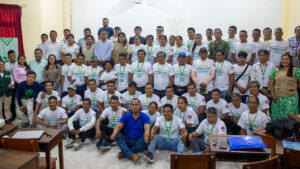
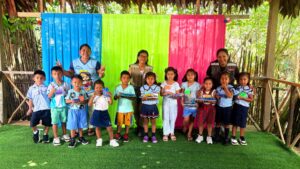
During September, the Community Relations team at Green Gold Forestry (GGF) carried out the final module of the year, titled “Global Warming: Causes and Effects”, marking the conclusion of the 2025 cycle of the Environmental Curriculum. The sessions were conducted in four secondary-level schools located in the partner communities of San Luis de Tacsha and Copal Urco (Napo River Basin), as well as San Regis and Solterito (Marañón River Basin). A total of 73 students —42 boys and 31 girls— participated, along with four local teachers who actively supported the learning process.
“This type of initiative is highly motivating for students because they learn through real-life examples and reflect on what happens in their environment. Teachers also learn to integrate environmental education into our daily classes,” said Eduardo Rodríguez, teacher at the Native Community of San Luis de Tacsha Curaray.
The final module explored, in a participatory way, the causes and consequences of global warming through group dynamics, educational videos, guided debates, and local observation exercises. These methods encouraged students to reflect on the environmental changes observed in their communities and understand how daily actions can contribute to environmental care.
Using playful and practical approaches, facilitators promoted active participation among students, who shared their experiences regarding the impacts of climate change in their territories—such as shifts in rainfall patterns, declines in wildlife, and increases in temperature. These reflections were complemented by visual analysis and drawing activities, where students illustrated changes that occurred in their communities between 2020 and 2025. The exercise led to proposals and commitments focused on environmental care, including the sustainable use of natural resources and the promotion of recycling practices.
“Over the years, we’ve seen students become true environmental promoters within their schools and families. This process has generated shared learning and built a solid foundation to continue strengthening environmental education in these communities,” said Paula Diaz, Head of Community Relations at Green Gold Forestry.
GGF’s Environmental Curriculum is developed each year in coordination with community authorities, teachers, and local leaders, integrating additional modules such as “Circular Economy – Recycling” and “Biodiversity – Endangered Animals.” Its implementation reaffirms the company’s commitment to building local capacity, valuing ecosystems, and empowering new generations as guardians of the forest and the future of their territories.
Looking ahead to 2026, Green Gold Forestry will continue strengthening its environmental education program by incorporating new topics and approaches that address the current challenges facing the Amazon. In this way, the initiative will keep consolidating itself as a learning space that inspires new generations to understand, value, and protect their environment.